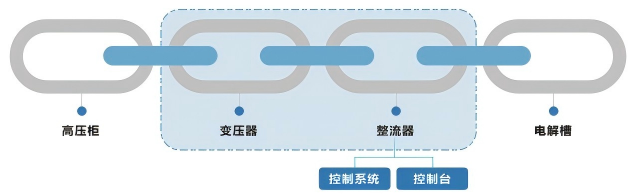
An electrolytic hydrogen production power supply is a device that produces hydrogen gas by electrolyzing water. It utilizes the principle of electrolysis to break down water molecules into hydrogen and oxygen. Specifically, an electrolytic hydrogen production power supply consists of a power source, an electrolytic cell, and a gas separation and purification unit. The power source provides electrical energy, the electrolytic cell is where the electrolysis reaction takes place, and the gas separation and purification unit separates and purifies the generated hydrogen and oxygen.
| Model | Customized according to customer requirements |
| Circuit Method | IGBT/PWM |
| Input Voltage | Three-phase AC380±10%, other options available upon request |
| Frequency | 50Hz/60Hz, other options available upon request |
| Output Voltage | 0-10000V (customizable upon request) |
| Output Current | 0-100000A (customizable upon request) |
| Output Accuracy | Current regulation accuracy ≤1% Voltage regulation accuracy ≤1% |
| Output Display | Digital voltage and current meter display (display and operation are separate from the main unit) |
| Adjustment Range | Current 0-maximum value, Voltage 0-maximum value |
| Efficiency | Overall efficiency >92% |
| Output Interface | Standard RS485, 4-20mA optional (ordering instructions) |
| Insulation Resistance | Input-output: 25mA; Input-chassis: ≥5mA; Output-chassis: ≥5mA |
| Insulation Strength | Input-output: AC1500V, 10mA, 1 minute; Input-chassis: AC1000V, 10mA, 1 minute |
| Operating Environment | -15-40%C |
| Protection Class | IP20 |
| Cooling System | Water-cooled vs. Air-cooled |
| Storage Temperature | Storage temperature: -20-50℃ |
| Insulation Class | Class B |
| Operating Status | Long-term continuous operation |
| Holding Mode | Phase loss, overheating, overcurrent, short circuit, undervoltage, and overvoltage protection |
It converts electrical energy into chemical energy, decomposing water into gas and oxygen through an electrolytic reaction. During electrolysis, current passes through water molecules; these molecules produce oxygen at the anode and gas at the cathode. This type of power source has many advantages, such as being environmentally friendly, highly efficient, and renewable, and is therefore widely used in energy storage, industrial production, and other fields.
1. Energy storage: Hydrogen electrolysis power sources can convert renewable energy sources such as solar and wind energy into chemical energy for storage, enabling long-term energy storage and utilization.
2. Industrial production: Hydrogen electrolysis power sources can be used to produce high-purity hydrogen for use in production processes in industries such as chemical engineering, metallurgy, and electronics.
3. Transportation: Hydrogen electrolysis power sources can provide hydrogen for hydrogen-powered vehicles, achieving the utilization of clean energy and reducing environmental pollution.
The rectifier power supply plays a crucial role in the hydrogen electrolysis process. Electrolysis is a process that uses electrical energy to separate water molecules into hydrogen and oxygen. The rectifier power supply is used to convert alternating current (AC) into direct current (DC) required for electrolysis. During electrolysis, water is broken down into hydrogen and oxygen, which are collected at the electrodes. The rectifier power supply ensures that the appropriate voltage and current are applied to the electrodes, which is essential for efficient hydrogen production. The correct voltage is required to separate water molecules into hydrogen and oxygen, while the correct current ensures process consistency and optimizes hydrogen production rates.
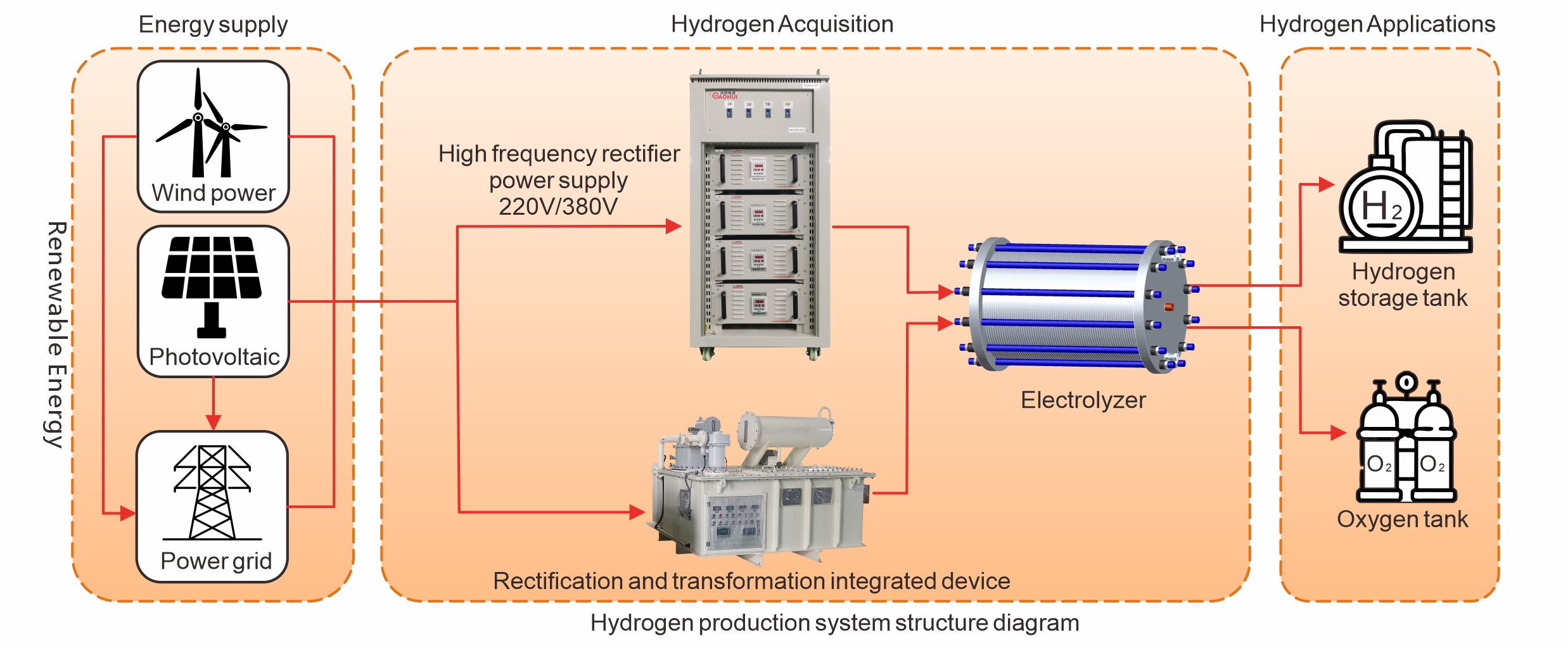
Schematic diagram of a high-efficiency, energy-saving integrated transformer-rectifier output DC power supply system